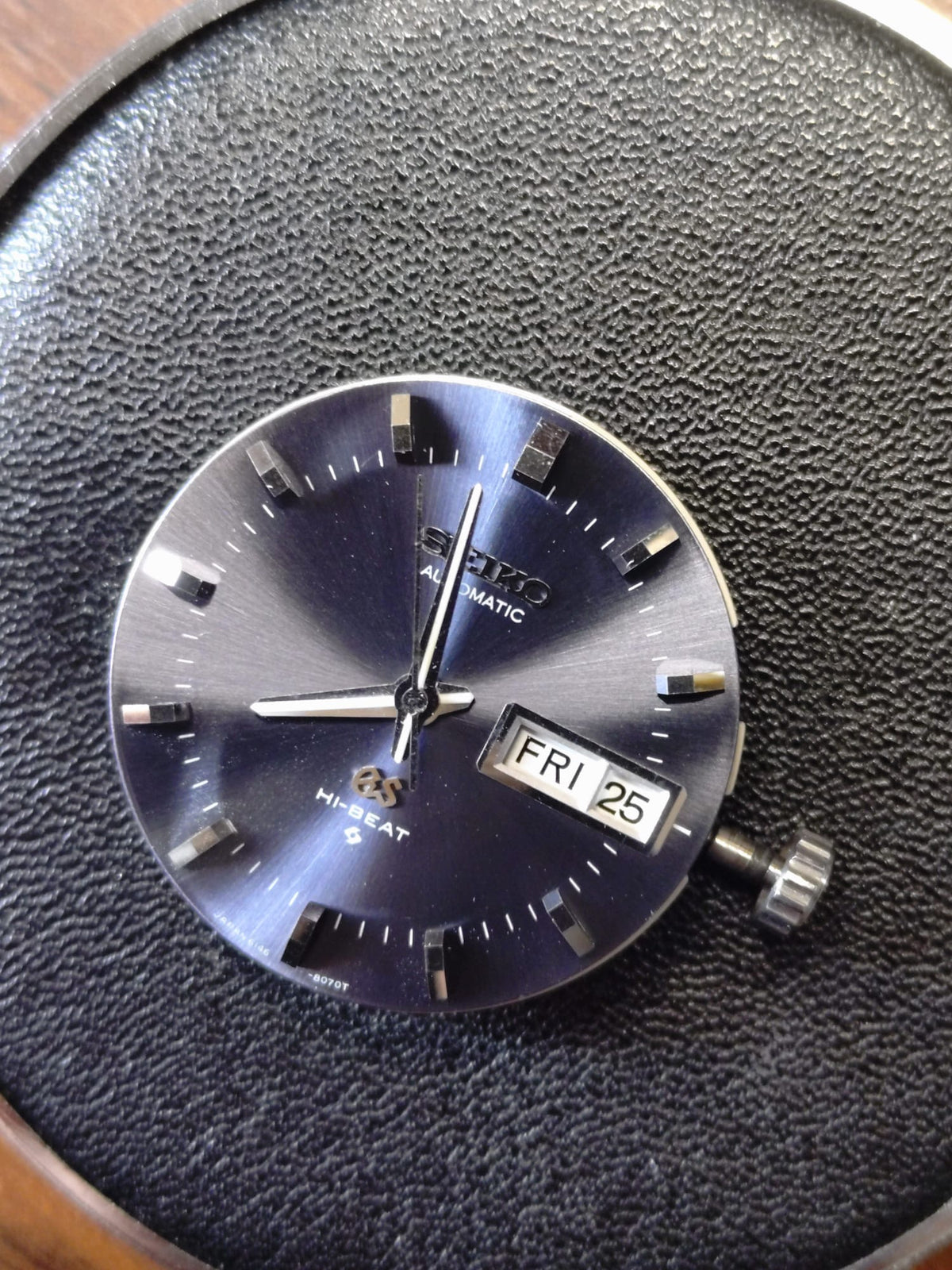


Grand Seiko 61GS Hi-Beat – Ref. 6146-8050 – Caliber 6146A, 36,000 vph, Suwa Seikosha – blue-grey dial, faceted crystal – May 1972 – freshly serviced
Grand Seiko 61GS Hi-Beat – Ref. 6146-8050 – Caliber 6146A, 36,000 vph, Suwa Seikosha – blue-grey dial, faceted crystal – May 1972 – freshly serviced
Ten beats per second.
That is what sets a 1972 Hi-Beat apart from almost everything else built at that time – and what only a few manufacturers even offer today. If you observe the second hand of this watch, you no longer see steps. You see a movement.
A reference that only existed for two months
The 6146-8050 is among the rarest Grand Seiko models of the classic era. Based on the consensus of the collector community, it was produced for only about two months in 1972: all known examples bear production dates from April or May 1972.
The serial number of this watch is 255389. Following the Seiko scheme – the first digit is the last digit of the year, the second digit is the month – this translates to May 1972. It thus originates from the final documented month of production for this reference.
Why Seiko built the 8050 for such a short time is unknown. What remains is a watch that is rarely seen on the market – and which occupies a special position in its design.
The case and the faceted crystal
Most 61-series Grand Seiko watches have a round case with a domed crystal. The 8050 does not. It features an angular, wide-drawn case in the style of the early 1970s – topped with a faceted crystal, whose ground edge surfaces refract light at the edge of the dial.
This effect is the watch’s true appeal. Depending on the angle, narrow bands of light appear at the edge of the crystal, running around the dial. This is almost impossible to photograph; you have to turn the watch in your hand.
This also has practical implications: these crystals are no longer available today. A damaged faceted crystal can only be replaced with a standard round one, causing the watch to lose its character. The crystal on this piece is flawless and original – the most important condition factor for this reference.
The case itself is hand-polished using the Zaratsu method: a process in which the workpieces are guided against a rotating disc to create completely distortion-free, mirror-like surfaces. Grand Seiko still uses this method today, and it is the reason why the surfaces on these cases look different than on machine-polished watches – free of waviness, with razor-sharp edges against the brushed sections.
This is based on the design language formulated by Taro Tanaka at Seiko, which became canonical with the 1967 44GS: flat surfaces instead of rounded transitions, with every surface reflecting light in a defined direction, and no edge ever softened by polishing.
The 6146A caliber
The 61GS series appeared in February 1968 – introduced not in the catalog, but in Seiko's dealer magazine. It brought the first Japanese automatic movement with 36,000 semi-oscillations per hour.
- Automatic with additional manual winding
- Seconds stop (hacking) when the crown is pulled
- 25 jewels, 36,000 bph – ten beats per second, 5 Hz
- Day and date with quick-set
- Manufactured by Suwa Seikosha
The purpose of the high frequency: the faster the balance wheel oscillates, the less it is affected by external influences – shocks, changes in position, or acceleration while being worn. The balance returns to its rhythm more quickly, and the rate becomes more stable. The price is higher wear and more complex construction, which is why such movements were used exclusively in top-tier lines.
The Grand Seiko Standard
Seiko subjected the 6145A and 6146A calibers to the in-house Grand Seiko Standard: regulated to –3 to +5 seconds per day, tested in several positions and at different temperatures.
This standard was stricter than the Swiss chronometer certification in effect at the time. Seiko created it after Japanese watches competed against European rivals at the Neuchâtel Observatory accuracy competitions – where they advanced from the bottom of the rankings to the top within a few years.
Within the 61 series, there were two levels above this: the 6155A/6156A calibers designated as "Special" with ±3 seconds, and the V.F.A. 6185/6186 movements with ±2 seconds, which were assembled by selected watchmakers using hand-picked components. This watch belongs to the base level – which itself was superior to what was considered a chronometer in Europe.
Suwa and Daini
Seiko maintained two competing production facilities: Suwa Seikosha in Nagano and Daini Seikosha in Tokyo. Both developed their own movements and competed against each other; management expressly encouraged this.
Grand Seiko was built by both – the 44GS, 45GS, and 45GS V.F.A. came from Daini, while practically everything else came from Suwa. This 61GS comes from Suwa, recognizable by the small swirl logo on the dial and case back. Daini responded to the 61GS with the manual-wind 45GS, which also ran at 36,000 semi-oscillations.
Suwa Seikosha later became Seiko Epson, and Daini Seikosha became Seiko Instruments.
Dial
The dial is rendered in a deep blue-gray – significantly rarer than the silver versions that make up the majority of 61GS production. A fine sunburst finish radiates from the center; depending on the light, the tone shifts between a light, bluish tin-gray and an almost anthracite-like dark.
The hour markers are applied, multi-faceted indices with razor-sharp edges and wide polished surfaces – a counterpiece to the case. These are paired with angular, similarly faceted hands and a slender central seconds hand.
The dial is sparsely labeled: SEIKO AUTOMATIC at the top, GS HI-BEAT with the Suwa logo at the bottom. The calendar window at three o'clock is framed with an applied border; Sunday is shown in red.
Condition
This watch is in truly excellent condition.
The faceted crystal is flawless and original – without scratches, chips, or cloudiness on the ground surfaces. For this reference, this is the deciding factor, as replacements are unavailable.
Technically flawless: the watch was professionally serviced in Japan in the spring/summer of 2026 – completely disassembled, cleaned, oiled, and regulated. The automatic system, manual wind, seconds stop, and quick-set for day and date all work perfectly.
The dial is clean and uniform, with no spots, discoloration, or fading. The lettering is complete and sharp, the applied indices are securely seated, show no corrosion, and have retained their edge definition. The calendar frame is intact.
The stainless steel case shows only very light, age-appropriate signs of wear. The Zaratsu-polished surfaces are preserved, the edges against the brushed sections are clearly defined – the watch has not been re-polished, which is the most important case criterion for Grand Seiko.
The GS-signed crown is original and clearly stamped; signed crowns were often replaced with simple spare parts during repairs over the decades. The gold medallion on the case back is completely preserved, and the embossing and Suwa logo are sharp. All case back engravings – reference 6146-8050, serial number 255389 – are clearly legible.
The watch is fitted with a new, high-quality Seiko leather strap.
Technical specifications
- Brand / Line: Grand Seiko, 61GS Hi-Beat
- Reference: 6146-8050
- Serial number: 255389
- Production date: May 1972
- Movement: Seiko Caliber 6146A, automatic with manual wind, 25 jewels, 36,000 bph, seconds stop
- Manufacturer: Suwa Seikosha, Japan
- Regulation: Grand Seiko Standard, –3 to +5 seconds per day
- Functions: Hours, minutes, central seconds, day and date with quick-set
- Case: Stainless steel, Zaratsu polishing, GS-signed crown, gold medallion on the case back
- Diameter (without crown): 37.9 mm
- Height: 12.8 mm
- Lug-to-lug: 41.9 mm
- Lug width: 18 mm
- Weight (incl. strap): 61 g
- Strap: New Seiko leather strap
- Crystal: Original faceted crystal
- Service: Spring/summer 2026, Japan – full disassembly, cleaning, oiling, regulation
For whom
For collectors searching for a vintage Grand Seiko who do not want the reference everyone else has. The 6146-8050 was built over a two-month period; it appears on the market only occasionally, and even more rarely with an intact, original faceted crystal.
For those who want a Hi-Beat movement on their wrist. 36,000 semi-oscillations were the pinnacle of what was technically possible in 1972, and in a way, they remain so – only a few manufacturers build movements at this frequency today.
And for anyone who has seen what a faceted crystal does with light. You turn the watch, and a narrow bright band follows along the edge of the dial. You will find that on almost no other watch.
With a diameter of 37.9 mm and a lug-to-lug of only 41.9 mm, it wears with presence but compactly – the short, angular lugs make it wearable even on medium-sized wrists.
Warranty (used)
This is a used item. The limitation period for claims for defects (statutory warranty) is 12 months from delivery.
Note
As this is a vintage watch, water resistance cannot be guaranteed. To protect the movement, the watch should not come into contact with water or moisture.
Legal guarantee:
Share