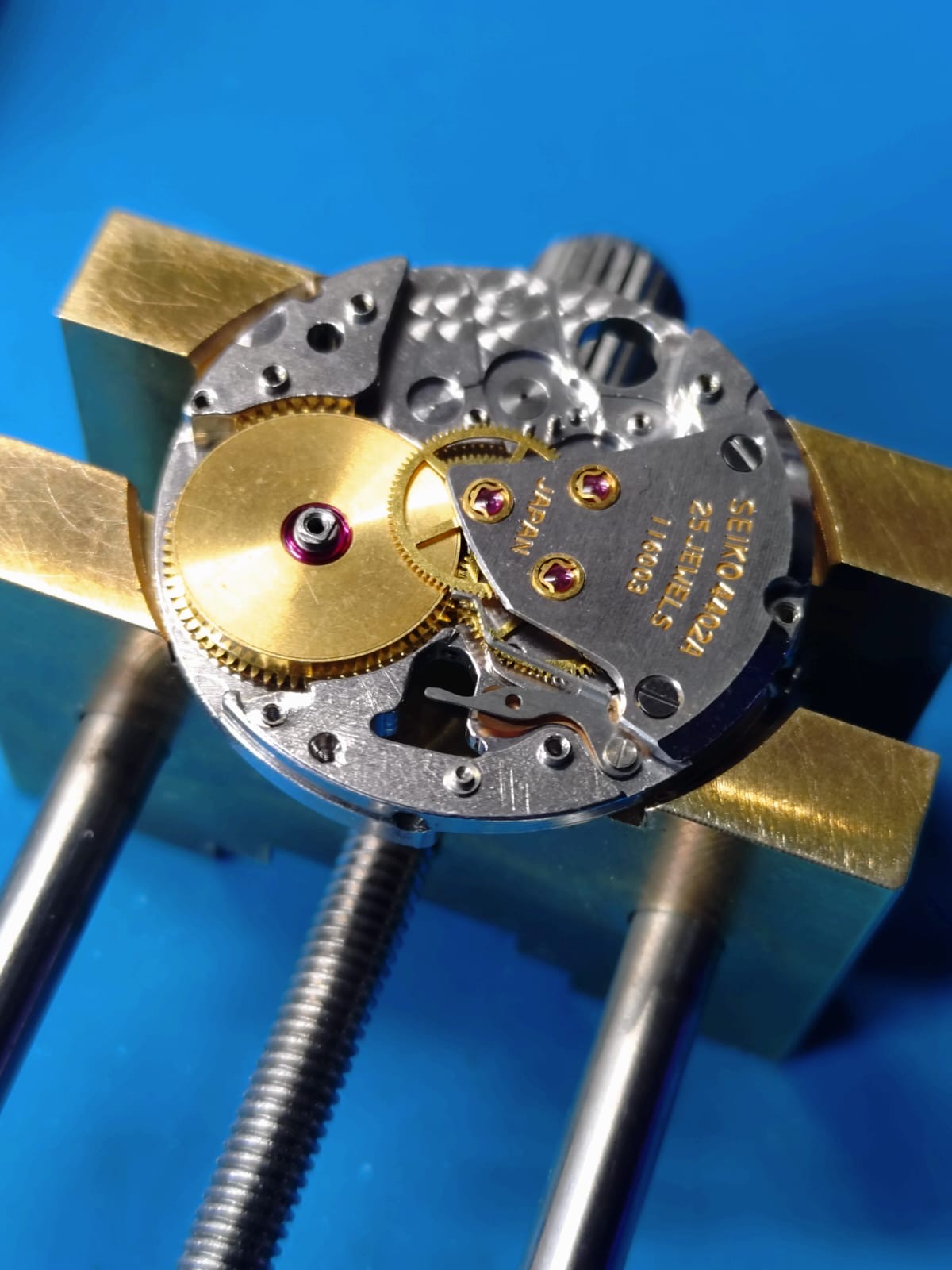


King Seiko 44KS – Ref. 4402-8000 – Caliber 4402A, manual wind with hacking seconds, Daini Seikosha – medallion case back – September 1966 – freshly serviced
King Seiko 44KS – Ref. 4402-8000 – Caliber 4402A, manual wind with hacking seconds, Daini Seikosha – medallion case back – September 1966 – freshly serviced
This watch is the beginning.
Not the beginning of King Seiko – the line had existed since 1961. Rather, the beginning of that design language that continues to define Seiko and Grand Seiko to this day. The 4402-8000 is considered the first reference in which Taro Tanaka’s "Grammar of Design" was fully implemented. Two years later, Grand Seiko adopted this aesthetic for the 44GS – the model the brand still cites as its foundation today.
Anyone who wants to understand where Grand Seiko gets its look from needs to hold this watch in their hands.
The Grammar of Design
In 1959, Daini Seikosha hired a young designer named Taro Tanaka. His initial observation was uncomfortable: in the display cases of Japanese jewelers, their own watches looked dull compared to the Swiss competition. Not built worse – but they didn't catch the light.
In 1962, Tanaka formulated three rules from this:
- All surfaces and angles on the case, dial, indices, and hands must be flat and geometrically precise so that they reflect light directionally.
- The bezel is to be executed as a simple, two-dimensionally faceted curve.
- No distortion from any viewing angle; cases and dials are to be mirror-polished.
Practically speaking, this means: no rounded transitions, no softened edges, no domed surfaces. Each surface stands on its own and casts light in exactly one direction.
On this watch, you can see it in the lugs. They are wide, flat, and divided into two planes by a sharp edge – mirror-polished on top, beveled at the outer edge. These lugs are the hallmark of the 44KS and the reason why this series has a distinct reputation among collectors.
Because the bezel is very slim and the dial reaches almost to the edge of the case, the watch appears significantly larger than its 35.2 mm – with a lug-to-lug distance of 41.7 mm, it wears with presence.
Daini vs. Suwa
Seiko maintained two completely separate production facilities that competed against one another: Daini Seikosha in Tokyo and Suwa Seikosha in Nagano. Both developed their own movements and vied for the top position; corporate management explicitly encouraged this.
In 1960, Suwa introduced the first Grand Seiko. Daini responded in 1961 with the first King Seiko, and in 1964 with the second generation – the 44KS, which is the subject here. King Seiko was never second best: it was priced just below Grand Seiko, but came from the other house and led the way in design.
The proof of this lies in the chronology. The Grammar of Design appeared first on this King Seiko. Grand Seiko followed.
The Caliber 4402A
- Manual wind, 25 jewels, 18,000 vibrations per hour
- Hacking seconds – a rarity in 1964 and proof of the series' ambitions
- Date at three o'clock with a semi-quickset mechanism
- Diashock shock protection, Seiko’s own balance bearing system
- Manufactured by Daini Seikosha, Tokyo
The hacking seconds feature deserves a note. It means that the watch stops when the crown is pulled out, allowing it to be set to the exact second against a time signal. A watch that runs within a few seconds a day but is off by half a minute when setting it is of no use to anyone – Seiko drew this conclusion in the mid-1960s, at a time when it was far from standard practice in Europe.
The 4402 itself evolved from the Cronos movement of the late 1950s, with which Daini had countered Suwa's Marvel. The same construction later yielded the more finely regulated 4420, which Seiko continued as the Grand Seiko 4420-9000 at the end of 1966.
The shield medallion
On the case back sits a gold medallion with the KING SEIKO inscription above a striped coat of arms with a crown.
Seiko used this version only from 1964 until about early 1967; it was then replaced by a medallion featuring the Seiko logo. It is thus the rarer of the two variants – and at the same time the more fragile: the medallions are set in, not screwed on, and on many examples they are damaged, worn smooth, or lost entirely.
On this watch, it is completely preserved, with sharp embossing of the lettering, shield, and crown. On a 44KS, this is the second criterion collectors look for after the case shape.
In addition, the case back bears the reference 4402-8000, the SGP mark for Seiko’s in-house gold-plating process, and "WATER PROOF" – the common terminology used before the new regulations for water resistance labeling around 1970.
Dial
The dial is rendered in a light, finely grained silver tone that diffuses light rather than reflecting it – the calm counterpoint to the mirror-like case. The hour markers are applied, faceted gold batons with sharp edges, executed as a double index at twelve o'clock. This is complemented by slender gold-colored dauphine hands and a fine center-seconds hand.
The dial is signed with the applied golden SEIKO logo at the top and KING SEIKO / DIASHOCK 25 JEWELS at the bottom. The date window at three o'clock is framed with an applied gold border.
Condition
First, the caveat: The gold plating is significantly worn. This affects the lug tips, the case edges, and the flanks; a darker, partially greenish area is visible on the lower right lug edge. This is visible in the photos. Those looking for a flawless case should choose an example in stainless steel – though one in comparable condition would cost many times more.
Against this is what is intact, and that is the crucial factor for this reference:
Technically perfect. The watch was professionally serviced in Japan in the spring/summer of 2026 – completely disassembled, cleaned, oiled, and regulated. Manual winding, hacking seconds, and date switching all function perfectly.
The dial is very well preserved: uniform grain without spots or discoloration, lettering is complete and sharp, the applied indices and SEIKO logo are firm and without corrosion, and the date frame is intact.
A gold-plated GS crown is fitted instead of the KS crown.
The shield medallion is complete and the embossing is sharp. The characteristic lug facets are preserved – the watch has not been over-polished, which is the most important single detail for a case that derives its effect solely from the sharpness of its edges. All case back engravings are clearly legible. The crystal has light signs of wear.
It is mounted on a new brown Seiko leather strap.
Technical Specifications
- Brand / Line: King Seiko, 44KS (second generation)
- Reference: 4402-8000
- Serial number: 6901193
- Production date: September 1966
- Movement: Seiko Caliber 4402A, manual wind, 25 jewels, 18,000 vph, hacking seconds, Diashock
- Manufacturer: Daini Seikosha, Japan
- Functions: Hours, minutes, center seconds, date
- Case: gold-plated (SGP), case back with gold King Seiko shield medallion
- Diameter (without crown): 35.2 mm
- Height: 11.3 mm
- Lug-to-lug: 41.7 mm
- Lug width: 18 mm
- Weight (incl. strap): 47 g
- Strap: new high-quality Seiko leather strap
- Crystal: acrylic glass
- Service: Spring/summer 2026, Japan – complete disassembly, cleaning, oiling, regulation
For whom
For collectors who want to map the full design history of Grand Seiko. The 4402-8000 is the reference where the Grammar of Design was first implemented – two years before the 44GS, which Grand Seiko still cites today.
For anyone looking for a manual-wind watch with hacking seconds. In 1966, this was a rarity, and it remains the difference between a watch that runs accurately and one that can be set accurately.
For fans of the 44KS lugs. These wide lugs divided into two planes are found on no other series in this form, and they are the reason why the watch looks so much larger on a 35 mm case.
And for anyone looking for a King Seiko with a complete shield medallion – the earlier and rarer of the two versions, which Seiko only used until early 1967. The worn gold plating makes this example accessible without lacking anything historically or technically.
Warranty (pre-owned)
This is a pre-owned item. The limitation period for claims for defects (statutory warranty) is 12 months from delivery.
Note
As this is a vintage watch, water resistance cannot be guaranteed. To protect the movement, the watch should not come into contact with water or moisture.
Legal guarantee:
Share