

King Seiko Hi-Beat 5626-7113 – Caliber 5626A, Suwa Seikosha – Stainless steel – June 1974 – freshly serviced
King Seiko Hi-Beat 5626-7113 – Caliber 5626A, Suwa Seikosha – Stainless steel – June 1974 – freshly serviced
¥28,000. That was the cost of this watch in the 1975 Seiko catalog.
For comparison, on the same page were: the King Seiko Special from the Daini factory at ¥30,000, the King Seiko Chronometer at ¥33,000 – and the Grand Seiko 56 series at ¥47,000.
So, the Grand Seiko wasn't twice as good. It was twice as expensive. The movement inside came from the same production line and shared the same design.
King Seiko – the line from the other factory
For decades, Seiko maintained two completely separate production facilities that competed against each other: Suwa Seikosha in Nagano Prefecture and Daini Seikosha in Tokyo. Both developed their own movements, maintained their own model lines, and vied for the top position. Corporate management explicitly encouraged this—whoever built the better movement received the order.
In 1960, Suwa introduced the first Grand Seiko. Daini responded in 1961 with the first King Seiko. What followed is one of the most productive rivalries in watchmaking history: the 44KS in 1964, the 45KS with 36,000 vibrations per hour in 1968, and in parallel, the 52 series from Tokyo.
With the 56 series, the situation reversed. Caliber 5626 comes from Suwa—the same factory that built the Grand Seiko. Suwa thus supplied both the Grand Seiko and, under the King Seiko name, its direct in-house competition. The Grand Seiko caliber 5646 and this King Seiko caliber 5626 share the same basic architecture; they were distinguished by fine regulation, features, and finishing.
This explains the 1975 catalog price—and it explains why the 56KS is the most sensible entry point into the classic Seiko top tier today.
"Hi-Beat" – what’s on the dial
The KS HI-BEAT lettering denotes the high oscillation frequency of the movement: 28,800 vibrations per hour, which is eight oscillations of the balance wheel per second.
The logic behind this is simple. The faster a balance wheel oscillates, the less external disturbances—shocks, changes in position, accelerations while worn—affect the timekeeping. A fast-oscillating balance wheel returns to its rhythm more quickly. The price is higher wear and more complex construction, which is why Hi-Beat movements were exclusively used in the top lines at the time of their introduction.
This is visible in the seconds hand: it runs noticeably smoother than in a movement with 18,000 or 21,600 vibrations per hour.
Caliber 5626A
- Automatic with additional manual winding
- Hacking seconds (stops when the crown is pulled out) – for precise time setting
- 25 jewels, 28,800 vibrations per hour
- Day and date with quick-set
- Day wheel is bilingual, Japanese and English
- Manufactured by Suwa Seikosha, Japan
The bilingual day wheel follows the Japanese calendar convention: Sunday in red, Saturday in blue. In the photo, the Sunday character 日 is in red—a detail not found on European watches that reveals the watch's origin at a glance.
The later case execution
A word on the design, as it differs from the earlier 56KS: The 5626-7113 has a conventional case back that opens from the rear and is stamped "WATER RESISTANT." The early references of the series, such as the 5626-7000, were still designed with movement removal from the front through the crystal and were consequently marked "WATERPROOF"; they also featured a gold medallion on the back.
Seiko simplified these details over the course of the model series—by 1974, the company was already under the cost pressure of quartz technology. Practically speaking, the later version means it is easier to maintain, as every overhaul is performed through the back rather than via the dial side. For collectors, it means less ornamentation on the back. It changes nothing about the movement or its accuracy.
Dial and case
The dial is executed in a light silver tone with a fine radial sunburst finish that moves across the surface from the center outward in changing light. The hour markers are applied, multi-faceted batons with sharp edges and deep black flanks; at twelve o'clock, they are executed as a double index. This is complemented by slender polished hands and a fine center seconds hand.
The dial is sparsely labeled: SEIKO AUTOMATIC at the top, KS HI-BEAT with the Suwa symbol at the bottom. The calendar window at three o'clock is framed with an applied border and shows the day of the week and date side-by-side.
The stainless steel case follows the design language that Taro Tanaka formulated at Seiko as the "Grammar of Design": flat, sharply defined surfaces instead of rounded transitions, angular lugs, and a flat bezel. Tanaka's principle was that each surface should reflect light in a defined direction—which only works as long as the edges remain crisp.
With a diameter of 36.3 mm, a lug-to-lug distance of just 41.4 mm, and a height of 10.5 mm, the watch remains compact and fits even smaller wrists well.
Condition
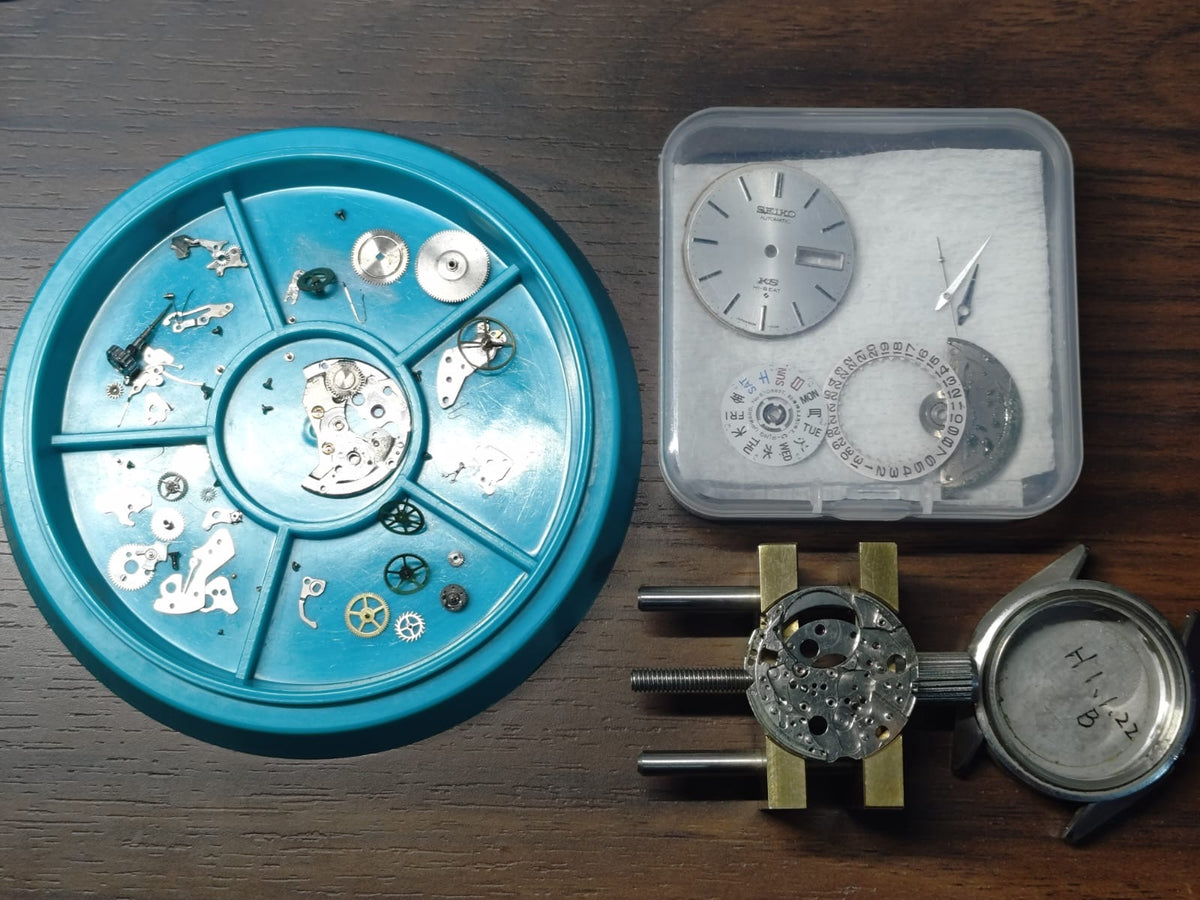
Technically flawless. The watch was professionally overhauled in Japan in the spring/summer of 2026—fully disassembled, cleaned, oiled, and regulated. Automatic winding, manual winding, hacking seconds, and the quick-set for day and date all work perfectly.
The dial is well preserved: the sunburst finish runs evenly throughout, without spots or lightening in the center. The lettering is complete and sharp, the applied indices are firmly seated and free of corrosion, and the calendar frame is intact. There is slight discoloration at the very edge of the dial, along with a few tiny dots on the minute track—imperceptible when worn, but recognizable in macro shots.
The stainless steel case shows age-appropriate signs of wear, more noticeably in places on the bezel edge and the lug flanks. The transitions between surfaces are preserved; the watch has not been over-polished. The case back has scratches from opening and wearing; all engravings—reference 5626-7113, serial number, Suwa symbol—are complete and clearly legible. The crystal has slight signs of use.
A new Seiko leather strap is fitted.
Dating
The serial number 464273 allows for identification according to the Seiko scheme: the first digit indicates the last digit of the production year, the second the month. 4 – 6 results in June 1974. The King Seiko line was discontinued a year later; this watch thus originates from the final phase of the classic era.
Technical specifications
- Brand / Line: King Seiko, Hi-Beat
- Reference: 5626-7113
- Serial number: 464273
- Production date: June 1974
- Movement: Seiko caliber 5626A, automatic with manual winding, 25 jewels, 28,800 vph, hacking seconds
- Manufacturer: Suwa Seikosha, Japan
- Functions: hours, minutes, center seconds, day and date with quick-set, bilingual day wheel (Japanese/English)
- Case: stainless steel
- Diameter (without crown): 36.3 mm
- Height: 10.5 mm
- Lug-to-lug: 41.4 mm
- Lug width: 18 mm
- Weight (incl. strap): 48 g
- Strap: new Seiko leather strap
- Crystal: acrylic glass
- Overhaul: spring/summer 2026, Japan – full disassembly, cleaning, oiling, regulation
For whom
For anyone looking for a mechanical Seiko at the Grand Seiko level without paying that price—with shared movement architecture from the same factory. The 1975 catalog price proves how close these two lines were.
For collectors who want to document the Suwa side of Seiko history, and for anyone looking for a watch from the final phase of the classic King Seiko era—a year later, the line was no more.
And for daily use. Automatic with manual winding, hacking seconds, quick-set for day and date, high-frequency movement: after fifty-one years and an overhaul, it runs exactly as it should, and at 36.3 mm by 41.4 mm lug-to-lug, it is understated enough for any occasion.
Warranty (used)
This is a used item. The limitation period for claims for defects (statutory warranty) is 12 months from delivery.
Note
As this is a vintage watch, water resistance cannot be guaranteed. To protect the movement, the watch should not come into contact with water or moisture.
Legal guarantee:
Share