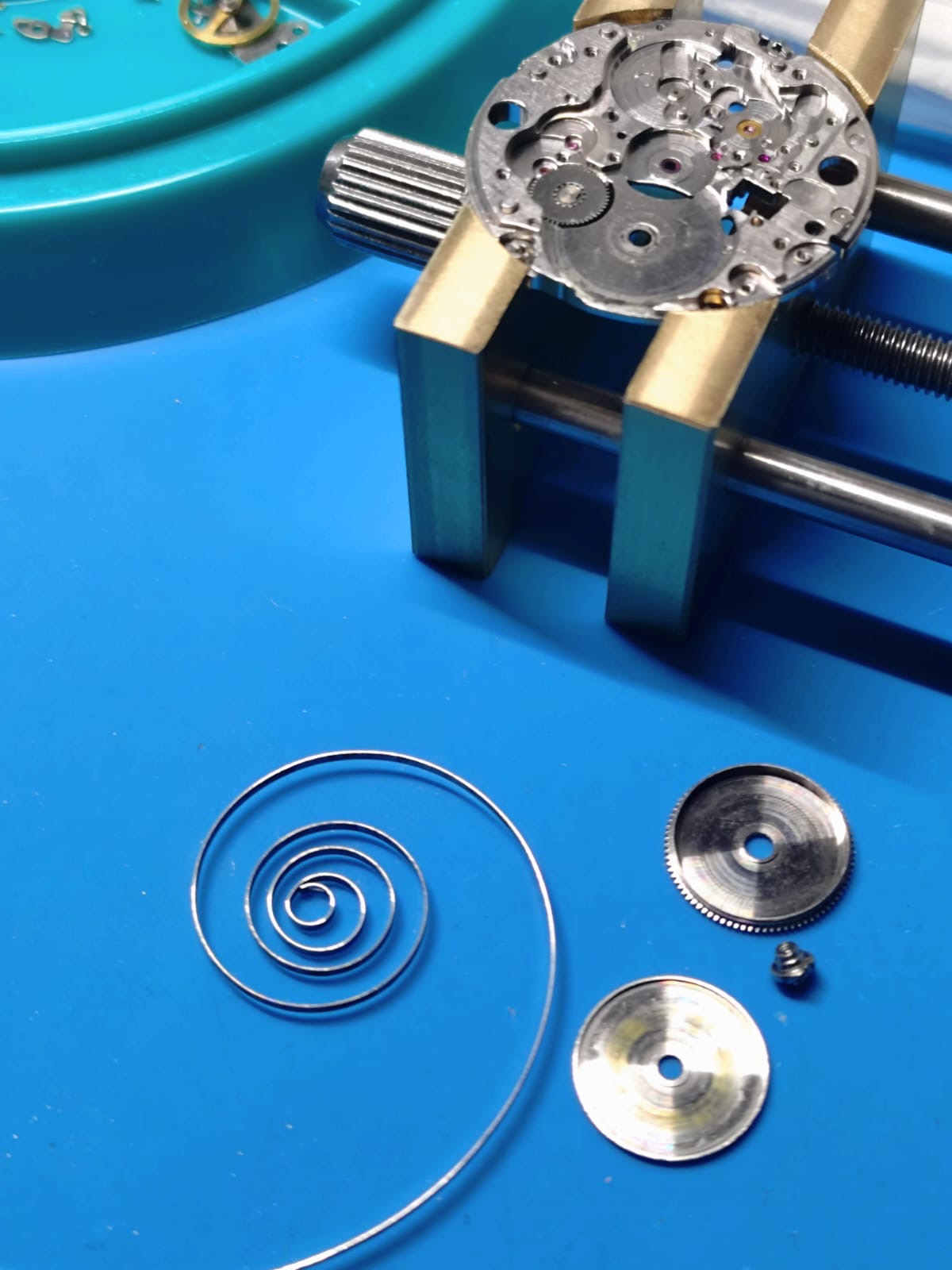


King Seiko Special 5256-8010 – Caliber 5256A, Daini Seikosha – the last King Seiko – service anniversary watch of Nagoya Neji Seisakusho, March 1975 – freshly serviced
King Seiko Special 5256-8010 – Caliber 5256A, Daini Seikosha – the last King Seiko – service anniversary watch of Nagoya Neji Seisakusho, March 1975 – freshly serviced
In 1975, Seiko discontinued the King Seiko. Fourteen years after the line's inception, in the midst of the Quartz Crisis, the name vanished from the catalog – and did not return until 2021.
This watch was built in March 1975. It is the last design that Seiko released under this name, and it was produced only in that single year.
And we know to whom it belonged.
The Engraving
There are two lines on the caseback:
永年勤続25年記念 – In commemoration of twenty-five years of service.
KK名古屋螺子 – Kabushiki-gaisha Nagoya Neji Seisakusho, literally: Nagoya Screw Manufacturing Co.
The name sounds modest. The company behind it is not.
Nagoya Neji Seisakusho
The company was founded in Nagoya in 1932 by Miyazaki Sadahachi and Watanabe Toshio, and transformed into a joint-stock company in 1936. From the beginning, its purpose was specialized: high-strength screws, bolts, and metal parts for the Japanese aviation industry, which was growing rapidly during those years.
Customers included Mitsubishi, Aichi Tokei Denki, and the naval arsenals. An economic history study estimates the share of Mitsubishi's Nagoya aircraft plant in production value from 1932 to 1935 at 82.7 percent. Fasteners were supplied for airframes and aircraft engines – components where material quality and dimensional accuracy directly determine life and death.
After 1945, the company shifted to civilian manufacturing:
- 1949 Resumption of supplies to Mitsubishi
- 1952 Parts for the Mitsubishi Willys Jeep
- 1954 Supplier to Honda as well as components for Pratt & Whitney aircraft engines
- 1978 Series production of tie-rod assemblies for aircraft
- 1984/1987 New plants in Komaki and Seki
- from 1989 Expansion into the USA, later Thailand and Indonesia
In the year 2000, the company renamed itself. It still operates today as MEIRA Corporation – メイラ株式会社 – and supplies the automotive, aviation, and aerospace industries. The name is likely a shortening of the old one: mei from Nagoya, ra from neji.
There is a printed corporate chronicle covering the first fifty years: "Fifty-Year History of Nagoya Neji," published in June 1983, 133 pages. Copies are verified at the Research Institute for Economics & Business Administration at Kobe University and the corporate history archive of Chuo University, among others.
Twenty-Five Years
Counting back from the engraving date, the recipient of this watch joined in 1950 – the year Nagoya Neji resumed postwar supplies to Mitsubishi.
He was therefore there from the beginning as the aviation supplier became an automotive supplier. He experienced the Jeep production of 1952, the entry into Honda in 1954, and the re-entry into aviation. When he received his watch in 1975, Japan was the second-largest economy in the world, and the company where he had worked for a quarter-century was part of the network of suppliers that supported this rise.
The Einen Kinzoku Hyosho, the honor for long-term service, was the visible expression of the lifetime employment that shaped Japanese working life for decades. What a company chose for this said something about how it valued the honoree. A King Seiko Special for ¥30,000 was at the upper end of what was awarded.
It is remarkable that this program still exists. MEIRA continues to honor years of service after 15, 25, and 35 years – today with special leave and vouchers instead of a watch. Whoever wears this King Seiko wears an earlier manifestation of a corporate tradition that persists ninety years after the company's founding.
King Seiko – The Line from the Other Factory
To understand what this watch is, one must understand how Seiko functioned at the time.
The corporation maintained two completely separate production facilities that competed against each other: Suwa Seikosha in Nagano Prefecture and Daini Seikosha in Tokyo. Both developed their own movements, maintained their own model lines, and competed for the top position. Corporate management explicitly encouraged this – whoever built the better movement received the contract.
In 1960, Suwa introduced the first Grand Seiko. Daini responded in 1961 with the first King Seiko. What followed is one of the most productive rivalries in watchmaking history: the 44KS in 1964, the 45KS with 36,000 vibrations per hour in 1968, in parallel the Suwa 56 series, and from 1971 the 52KS – Daini's last construction for this line.
King Seiko was never the second choice, but rather the watch from the other factory. In several disciplines, it was on par with the Grand Seiko, and in the chronometer versions, the King Seiko was even more broadly positioned.
By the way, Daini Seikosha became Seiko Instruments, and Suwa Seikosha became Seiko Epson. Both exist to this day – just like the company that gifted this watch.
Why Specifically the 52KS
For the automatic King Seikos, two movement families ran in parallel until the end: the 56 series from Suwa and the 52 series from Daini. Both were sold simultaneously, side by side in the same catalog.
The ratios are clear. The vast majority of classically styled King Seikos ran with the Suwa 56 movement. Only a handful of references received the Daini 52: the 5246-6000, 5246-6010, 5246-6020, 5246-7000, the 5256-8000, and this 5256-8010. Specialists consider the two 5256 models "unusual to rare."
In the 1975 Seiko catalog, the prices were listed side by side:
- Suwa King Seiko 5626-7113: ¥28,000
- Daini King Seiko Special 5256-8010: ¥30,000
- Suwa King Seiko 5626-7041 Chronometer: ¥33,000
- Grand Seiko of the 56 series (base model): ¥47,000
The 52KS Special was therefore not the entry-level model of the line, but ranked above the standard King Seiko and was priced closer to the chronometer version.
"Special" – What the Lightning Symbol Means
On the dial, it says KS SPECIAL, followed by a small lightning bolt symbol. This is not decorative.
Seiko tiered its movements according to internal accuracy classes. The "Special" designation denotes, according to general collector opinion, a version that was regulated to the next higher class than the base version of the same movement family. For Grand Seiko, this distinguished the 6155/6156 calibers from the base 6145/6146 movements; for King Seiko, "Special" identified the 5246 and 5256.
The preceding 5246 series also bore "Chronometer" on the dial. For the 5255/5256 models built from 1973 onwards, this designation was omitted, and "Special" remained as the sole quality mark. This watch thus carries the designation that Seiko used at the end of the King Seiko era for its best-regulated automatic movements.
The Caliber 5256A
- Automatic with auxiliary manual winding and hacking seconds
- 25 jewels, 28,800 vibrations per hour
- Day and date with quickset
- Bilingual day wheel, Japanese and English
- Manufactured by Daini Seikosha, Tokyo
The 5256A replaced the 5246A in 1973; the main innovation was a spring-loaded pawl for the date quickset, which made the mechanism significantly more robust. The movement was built until 1976.
Its history did not end there, however. The architecture of the 52 series became the foundation for the 4S series in the 1990s, with which Seiko resumed production of its high-end mechanical watches. Whoever wears a 5256 wears the last link of the classic era – and at the same time the construction upon which the later restart was built.
The End of an Era
In December 1969, Seiko presented the Astron, the world's first quartz wristwatch. Within a few years, this changed the entire market – and hit its own mechanical top models the hardest. A quartz watch was more accurate than any chronometer version and, within a short time, cheaper to manufacture.
By the mid-1970s, Seiko drew the consequence. The mechanical King Seiko and Grand Seiko vanished almost simultaneously. Grand Seiko returned in 1988, King Seiko not until 2021.
The 5256-8010 from 1975 stands exactly at this breaking point.
Case and Dial
The case follows the design language that Taro Tanaka formulated at Seiko in 1962 as the "Grammar of Design": flat, sharply defined polished surfaces, no rounded transitions, angular lugs, and a bezel executed as a flat surface rather than a curve. Tanaka's initial observation was simple – Japanese watches looked dull in the display case next to Swiss competition because their surfaces diffused light. His answer was to polish every surface flat and leave the edges crisp so that light would reflect in defined directions.
This only works as long as the edges are sharp. Any repolishing rounds them off and destroys the effect – which is why the condition of the case is the actual criterion for collectors of these models, not the dial.
The dial is a light silver tone with a fine grain that diffuses light rather than reflecting it. The hour markers are applied, multi-faceted batons, accompanied by slender faceted hands. The calendar window at three o'clock shows the day and date stacked in an applied frame – an arrangement that distinguishes the 52KS from the 56 models.
The day wheel is bilingual and can be toggled between Japanese and English. The Japanese version follows the country's calendar convention: Sunday in red, Saturday in blue – a detail not found on European watches.
The dial is sparsely labeled: SEIKO AUTOMATIC at the top, KS SPECIAL with the lightning bolt at the bottom.
Condition
This watch is in exceptionally good condition.
Technically flawless: It was professionally serviced by a watchmaker in Japan in the spring/summer of 2026 – completely disassembled, cleaned, oiled, and regulated. The automatic system, manual winding, hacking seconds, and the quickset for day and date work perfectly, as does the bilingual toggle of the day wheel.
The case is the crucial point. The transitions between surfaces are clearly defined, the contours are preserved, the proportions are unchanged – the watch has not been over-polished. Anyone who has ever held a refinished King Seiko in their hands will recognize the difference immediately: there, the edges are soft, the bezel appears rounded, and the interplay of light between the surfaces is lost. None of that is the case here. There are only slight, age-appropriate signs of wear.
The dial is clean and uniform, without spots, discoloration, or fading. The lettering is complete and sharp, the applied indices are firmly seated and show no corrosion, and the calendar frame is intact. The crystal is clear.
The caseback shows the usual fine marks from opening and wearing; the engraving, reference 5256-8010, and serial number are complete and clearly legible.
It is mounted on a new black Seiko leather strap.
Dating
The serial number 534311 allows for unambiguous identification according to the Seiko scheme: the first digit indicates the last digit of the production year, the second the month. 5 – 3 results in March 1975. This coincides with the documented production period of the reference, which, according to available sources, was built exclusively in 1975.
Technical Specifications
- Brand / Line: King Seiko, Special
- Reference: 5256-8010
- Serial number: 534311
- Production date: March 1975
- Movement: Seiko Caliber 5256A, automatic with manual winding, 25 jewels, 28,800 vph, hacking seconds
- Manufacturer: Daini Seikosha, Japan
- Functions: Hours, minutes, central seconds, day and date with quickset, bilingual day wheel (Japanese/English) with red Sunday and blue Saturday
- Case: Stainless steel, caseback with service anniversary engraving 「永年勤続25年記念/KK名古屋螺子」
- Diameter (excluding crown): 36.1 mm
- Height: 10.1 mm
- Lug-to-lug: 41.4 mm
- Lug width: 18 mm
- Weight (incl. strap): 50 g
- Strap: New Seiko leather strap
- Crystal: Mineral glass
- Service: Spring/summer 2026, Japan – complete disassembly, cleaning, oiling, regulation
For Whom
For collectors who want to fully document the King Seiko history. The 52KS is the rarer of the two automatic King Seiko movements, the 5256-8010 was built for only a single year, and the line ended with it. Those who already possess the Suwa 56KS get the Daini counterpart to the same rivalry.
For anyone seeking a mechanical Seiko of the classic era at a Grand Seiko level without paying that price – and who values an unpolished case.
And for anyone to whom provenance means something. Most vintage watches are anonymous; you know where they were built, but not who wore them. With this one, both can be proven: built in March 1975 at Daini Seikosha in Tokyo, presented by a company that has existed since 1932 and still exists today, to an employee who joined in 1950. There is even a printed company chronicle where the years this person spent there can be read.
With a diameter of 36.1 mm, a height of 10.1 mm, and 41.4 mm lug-to-lug, it wears discreetly and also fits smaller wrists. The bilingual day wheel makes it wearable for everyday use without limitation.
Warranty (used)
This is a used item. The limitation period for claims for defects (statutory warranty) is 12 months from delivery.
Note
As this is a vintage watch, water resistance cannot be guaranteed. To protect the movement, the watch should not come into contact with water or moisture.
Legal guarantee:
Share