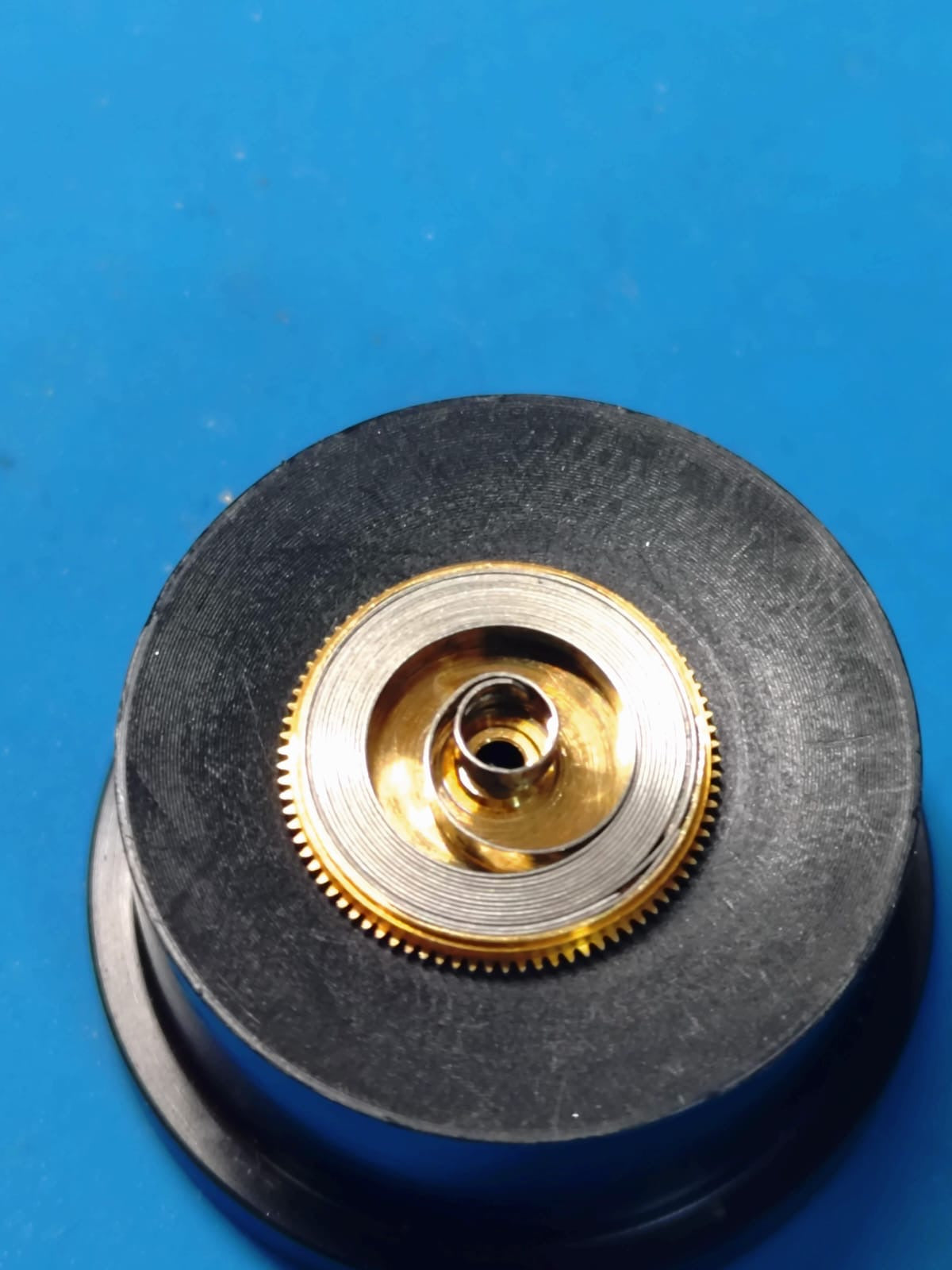


Rarity: Citizen Highness 36000 – Ref. 4-740203 Y – Caliber 7430, 36,000 bph automatic, chronometer quality – blue dial – October 1971 – freshly serviced
Rarity: Citizen Highness 36000 – Ref. 4-740203 Y – Caliber 7430, 36,000 bph automatic, chronometer quality – blue dial – October 1971 – freshly serviced
Ten beats per second, from Tokyo.
While Seiko occupied the Japanese top tier with Grand Seiko and King Seiko, Citizen was building watches in those same years that kept pace technically – and are significantly rarer to find today.
The Highness was the highest of them all.
What "Highness" means
Citizen introduced the designation as the top-tier version of the Leopard series. The difference was not in the case or the dial, but in the movement: Highness models ran consistently at 36,000 vibrations per hour and were regulated to chronometer standards.
Citizen itself described the series as an "excellent class of chronometer." The Highness models did not carry official certification from an independent testing body – but the in-house testing was strict, and the tolerances published by Citizen for the top grades fell within a range that the modern Swiss chronometer test does not undercut.
In terms of pricing, Citizen positioned the Highness at the level of the King Seiko. In actual substance, it competed against the Grand Seiko 61GS – the automatic 36,000 bph movement from the Suwa factory, which represented Seiko’s technical peak during those years.
Those who wish to compare both paths can do so directly here: in the same inventory, you will find a Grand Seiko 61GS with the same 36,000 automatic movement from the Suwa factory. It costs approximately double. The difference lies not in the frequency, not in the level of ambition, and not in the year of manufacture – but in the name on the dial and the brand's renown among collectors.
What 36,000 vibrations mean
Ten beats per second. That is the frequency that was considered the technical maximum in the late 1960s and early 1970s and which only a few manufacturers were able to master in serial production.
The logic behind it: The faster the balance wheel oscillates, the less external disturbances – shocks, changes in position, accelerations while wearing – affect the accuracy. A fast-oscillating balance wheel returns to its rhythm more quickly. The price is higher wear and a more demanding construction, which is why such movements were used exclusively in top-tier lines.
This is visible in the seconds hand: it does not move in steps, but in a nearly gliding motion.
Caliber 7430
- Automatic, 36,000 vibrations per hour
- Date display at three o'clock with quick-set
- Regulated to chronometer standards
- Manufactured by Citizen, Japan
The 7430 belongs to the 74 movement family, the date version within Citizen's high-frequency movements. The related caliber 7230 additionally features a day of the week; the date-only variant makes the dial appear calmer and avoids the broad double block of the day-date models.
The movement family can be identified by the reference: the case number 4-740203 Y points directly to the 74 caliber. The case back also bears the engraving AUTOMATIC as well as the serial number 11030762.
"Para Water"
Next to this is a word on the back that no longer exists today: PARA WATER.
Citizen coined it in 1959 for the first fully water- and dust-proof wristwatch of Japanese manufacture – "para" for protection, "water" for what was being protected against. The construction was based on O-rings made of a specially developed nitrile rubber and was designed for 50 meters.
Citizen proved the technology publicly at the time: in 1962, Kenichi Horie took two Parawaters with him when he became the first person to cross the Pacific alone and non-stop in a sailboat. Starting in 1963, Citizen attached Parawaters to research buoys and deployed them into the Kuroshio Current; years later, buoys were recovered on the American West Coast – the watches were still running.
The designation disappeared from the Citizen program shortly after the time this watch was produced.
Dial and case
The dial is rendered in a deep, muted blue that shifts between navy and nearly black depending on the light. The surface is smooth and understated – no sunburst, no texture, no luminous material.
The hour markers are applied, faceted batons with polished flanks and cream-colored tops; executed as a double index at twelve o'clock. They are the only bright spot on an otherwise dark surface and carry the contrast alone. Complementing this are slim polished hands and a fine central seconds hand.
The dial is inscribed in two lines: above, CITIZEN / AUTOMATIC; below, the CH emblem of the Highness series with the specification 36000. There is nothing more on it – and nothing more is needed.
The date window at three o'clock is enclosed by an applied, polished frame.
The stainless steel case has an angular, flat-cut shape with broad, tapering lugs and a narrow, flat-finished bezel. With a diameter of 37.3 mm, a lug-to-lug of 42 mm, and a height of only 10.3 mm, it is powerfully proportioned while remaining flat.
The mineral crystal is flat with a faceted edge – a Citizen quirk of those years that refracts light at the edge of the dial.
Condition
Technically flawless. The watch was professionally overhauled by a watchmaker in Japan in the late summer of 2026 – completely disassembled, cleaned, oiled, and regulated. During this process, a gear of the calendar mechanism was replaced; the automatic winding and date quick-set function work perfectly.
Especially with a 36,000 vph movement, this is the decisive point. The high frequency means twice as many oscillations as a movement with 18,000 vph and correspondingly higher wear. Simple cleaning is often not enough for these calibers – here, what needed replacing was replaced rather than overlooked.
The dial is very well preserved: the blue surface is uniform, without spots, fading, or discoloration. The applied indices are firmly in place and free of corrosion; the lettering and CH emblem are complete and sharp; the date frame is intact.
The stainless steel case shows age-appropriate signs of wear; the surface transitions are preserved, and the watch has not been over-polished. The case back shows the usual fine scratches from opening and wearing; all engravings are complete and clearly legible. The crystal is clear; the faceted edge is undamaged.
Mounted is a new blue ostrich leather strap that picks up the tone of the dial.
Technical specifications
- Brand / Line: Citizen, Highness 36000
- Reference: 4-740203 Y
- Serial number: 11030762
- Production date: October 1971
- Movement: Citizen caliber 7430, automatic, 36,000 vph, regulated to chronometer standards
- Functions: hours, minutes, central seconds, date with quick-set
- Case: stainless steel, case back with Parawater marking
- Diameter (without crown): 37.3 mm
- Height: 10.3 mm
- Lug-to-lug: 42 mm
- Lug width: 18 mm
- Weight (incl. strap): 51 g
- Strap: new blue ostrich leather strap
- Crystal: mineral glass, flat with faceted edge
- Overhaul: late summer 2026, Japan – complete disassembly, cleaning, oiling, regulation, replacement of a calendar gear
For whom
For true connoisseurs and for anyone looking for a Japanese high-frequency watch from the early 1970s who doesn't want to pay the Grand Seiko premium. Same frequency, same ambition, same time period, half the price.
For collectors who collect Japanese watches beyond Seiko. The Highness is Citizen's answer to Grand Seiko and King Seiko – and yet significantly fewer people know about it.
For anyone who wants a 36,000 vph movement on their wrist. This frequency was the pinnacle of what was technically possible around 1971 and has, in a certain way, remained so – only a few manufactures build movements of this type today. The fact that this example comes from an overhaul with a renewed calendar gear is not a minor detail, but the prerequisite for being able to wear it daily.
For lovers of understated dials. A deep blue, applied indices, two lines of text, a date window. No luminous material, no pattern, no third line. That is a design stance one must be able to afford.
And for anyone looking for a watch where history continues on the case back: Parawater was the word with which Citizen proved that a Japanese watch could survive for years in the open Pacific.
Warranty (used)
This is a used item. The limitation period for claims for defects (statutory warranty) is 12 months from delivery.
Note
As this is a vintage watch, water resistance cannot be guaranteed. To protect the movement, the watch should not come into contact with water or moisture.
Legal guarantee:
Share