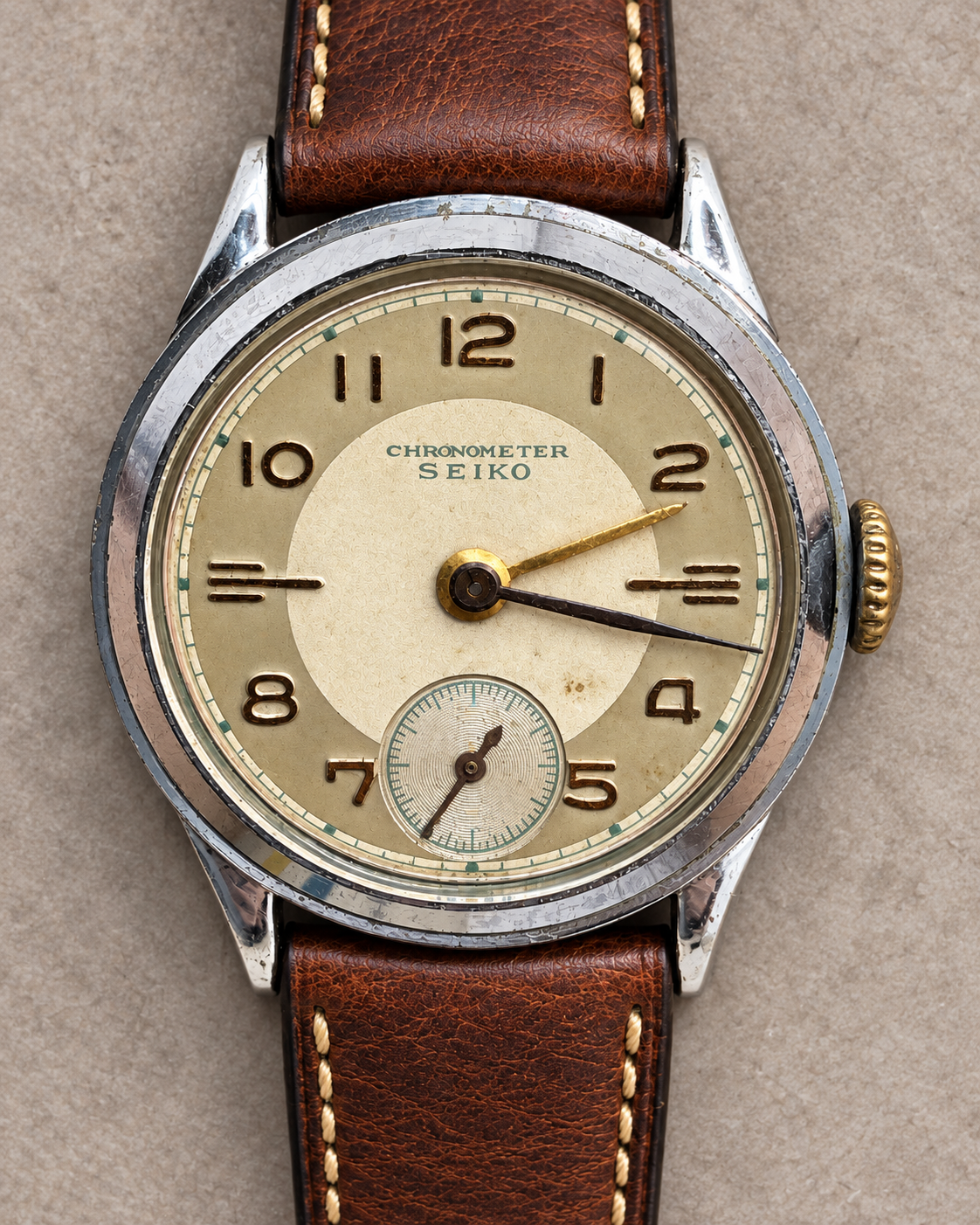


This watch is older than everything Seiko is famous for today.
Older than Grand Seiko, older than King Seiko, older than the 1956 Marvel – the watch that marks the beginning of Seiko's own historical record. It was built in July 1948, three years after the end of the war, in a country that was just beginning to rebuild its industry.
What an extraordinary gift for someone born in July 1948!
Why this particular piece is unusual
Seiko Chronometers appear on the market in Japan from time to time. You can find them – but you almost never find them in this condition.
The vast majority of listings are sold as "junk" or "function unverified": watches that do not run, have incomplete movements, damaged balance wheels, or refinished dials. The reason is simple. There is no longer a supply of spare parts for a 1948 movement; anyone wishing to repair such a watch needs donor movements, time, and a watchmaker capable of handling calibers from this generation. While a few such watchmakers still exist in Japan, they are rare in Europe.
Do the math: An unverified watch from Japan costs less, but you have to add the price of shipping, import duties, a full overhaul, and – very likely – spare parts. In the end, you will be far above the price of this watch, without knowing if the movement was even complete to begin with.
This one was fully serviced in Japan in the spring/summer of 2026 by a specialist (not every watchmaker in Japan can or wants to work on such old chronometers) and is running. That is the real difference compared to what is usually offered.
The Seiko Chronometers
The series appeared in the early 1940s and ran into the 1950s. It was equipped with the best movements Seikosha could build at the time and was aimed at buyers for whom accuracy was more important than anything else.
A word on the designation to avoid any misunderstanding: "Chronometer" was a model and quality designation by Seiko itself, not a certification by an independent testing body. An official Japanese chronometer test – the later Japan Chronometer Inspection Institution, which began testing King Seiko and Grand Seiko models in the 1960s – did not yet exist at the time. Seiko used the term to mark its own quality standards and lived up to them technically.
For collectors, these watches are interesting for another reason: they prove that Seiko was already building high-quality watches long before its rise in the 1960s. Exactly twelve years lie between this watch and the first Grand Seiko.
The Caliber 10A
The watch is powered by a manual-wind movement from the Caliber 10 family with a small seconds hand at six o'clock.
This movement family marks the beginning of Seiko's post-war history. It was used in the late 1940s in both the Tokyo Daini factory and the Suwa factory; in 1946, Suwa developed the Caliber 10A from it by giving the second wheel and the third wheel their own bridge and separate cocks. This was a design improvement that directly benefited accuracy – and it occurred in a year when Japan had to rebuild virtually everything from scratch.
This line formed the basis for the production that would produce the Marvel ten years later – Seiko's first fully in-house developed movement – and from that came the Crown, King Seiko, and Grand Seiko.
The movements of this era do not yet carry a numerical caliber designation in today's sense; Seiko only introduced the four-digit system in 1964. The classification as a 10A is derived from its design and production period.
Practically speaking, this means: wind it once a day, no date, no automatic winding, no quick-set. The basic function of mechanical timekeeping, cleanly executed.
Dating
The case serial number is 875786. According to the Seiko system – first digit is the last digit of the year, second digit is the month – this results in July 1948.
This classification is well-founded, even if not formally documented for watches from the 1940s: the Caliber 10A was created in 1946, the Chronometer series ran from the early 1940s, and the mathematically possible alternative of July 1958 is practically ruled out – by that time, the Marvel and Lord Marvel were already in the lineup, and dials of this type were no longer being produced.
The dial
Anyone familiar with 1960s Seiko dials – applied batons, sunburst finishes, minimalism – will find something completely different here.
The dial is two-tone: a lighter circle in the center, surrounded by a slightly darker outer ring. The hours are executed as printed Arabic numerals in a bold, slightly archaic font – with the exception of the three and nine o'clock positions, which each feature three parallel lines. These triple bars are the hallmark of the Chronometer dials.
At six o'clock, the small seconds hand sits in its own recessed sub-dial with a fine guilloché pattern that breaks the light into concentric rings. Small seconds of this type almost completely disappeared from the Japanese lineup with the shift to center seconds in the late 1950s.
The dial is labeled in two lines: CHRONOMETER above SEIKO. Encircling it is a fine printed minute track with turquoise marking dots.
It is a dial that you do not grasp at a glance, but rather one that you study.
Case
The case is chrome-plated, and the case back is made of stainless steel – the standard construction of those years, where the high-stress sealing surface rests on hard material. In addition to the material specification, the case back bears the manufacturer's mark in a rectangle, along with the case number 1049 and the serial number 875786.
With a diameter of 27.3 mm and 31.5 mm lug-to-lug, the watch is very small by today's standards. It corresponded exactly to what was considered a men's watch in Japan in the 1940s and 1950s: wristwatches had evolved from pocket watches, and they were worn to read the time, not to stand out.
The lug width is 15 mm.
The strap – and a suggestion
The watch is supplied as it came to us: on a contemporary stainless steel stretch bracelet. We have consciously left it as is. Such a bracelet is part of the appearance of this watch generation, and for a piece of this age, we believe it is more appropriate to show its inherited state rather than to modify it afterwards.
Nevertheless: This watch takes on a completely different look with a leather strap. The warm dial, the brown numerals, and the gold-colored crown harmonize with aged cowhide, while the steel bracelet breaks the tone. Anyone who wants to wear the watch, and not just own it, should consider the swap.
We are happy to assist with the selection. The 15 mm lug width is no longer common today, and not every strap of this width is proportional to a 27.3 mm case. Simply contact us after your purchase – we will suggest suitable straps and tell you where to find them.
Note regarding the final image
The final image is an artificial intelligence-generated representation and shows the watch on a brown leather strap. It serves exclusively to illustrate this design possibility. The leather strap shown is not included in the scope of delivery; the watch is delivered on the described stainless steel stretch bracelet. The actual condition of the case, dial, and crystal is determined exclusively by the other photographic images and the condition description below.Legal guarantee:
All goods come with a minimum 2-year legal guarantee in the EU.Learn more