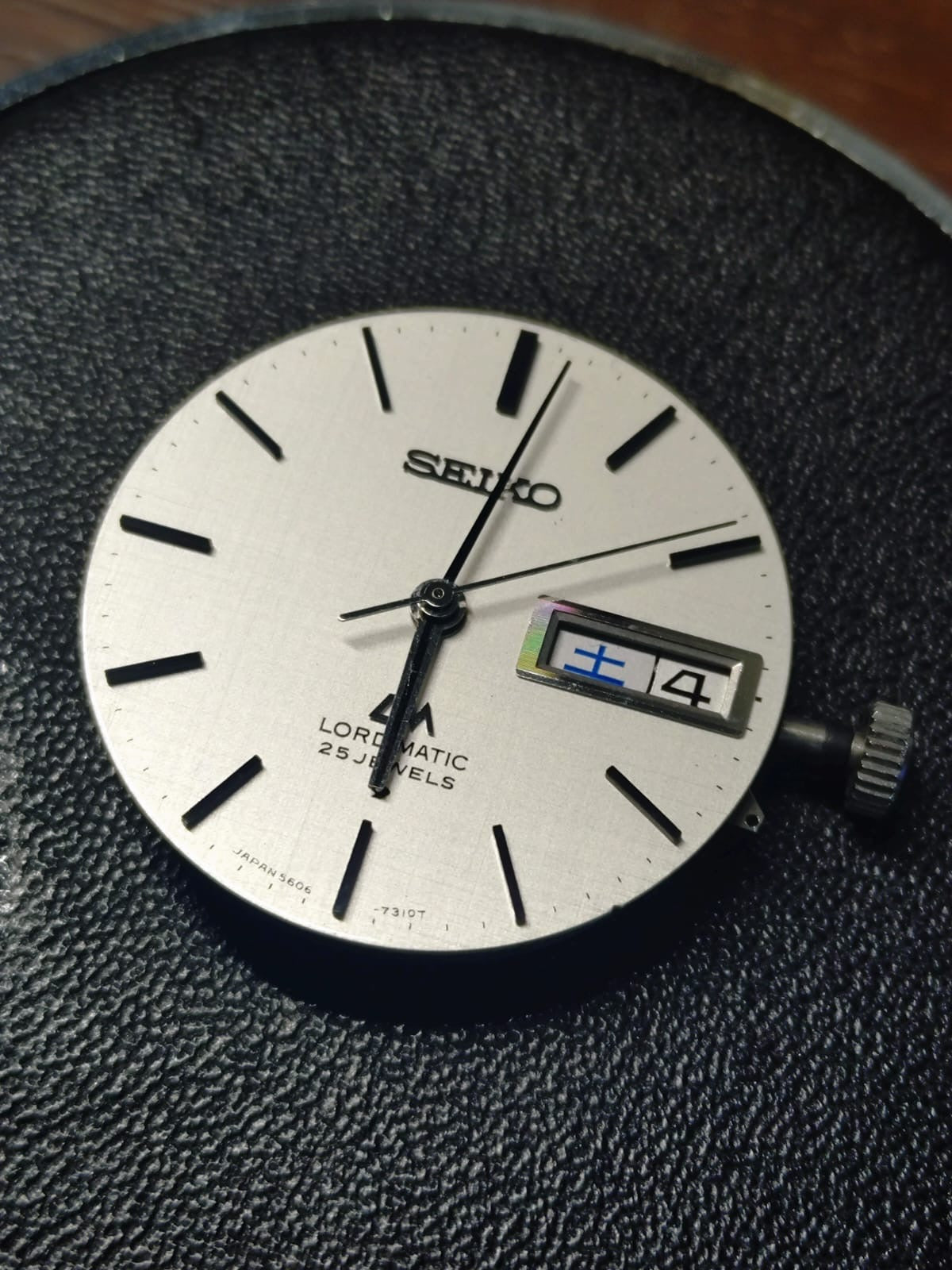


Seiko Lord Matic 5606-7130 – Caliber 5606, 25 jewels, Suwa Seikosha – Linen dial, monocoque case – July 1970 – freshly serviced
Seiko Lord Matic 5606-7130 – Caliber 5606, 25 jewels, Suwa Seikosha – Linen dial, monocoque case – July 1970 – freshly serviced
Hold this dial up to the light and look closely.
The silver surface is neither smooth nor sunburst. It features a fine, cross-hatched pattern reminiscent of a linen weave—vertical and horizontal lines that overlap and refract light in two directions simultaneously.
When you tilt the watch, the luster does not travel across the surface as a single beam, but as a shimmer across the entire dial. This is a completely different effect than that of the standard Seiko dials of those years—and the reason why linen dials are specifically sought after today.
A case without a back
The case back bears an instruction directed not to the wearer, but to the watchmaker: OPEN THRU GLASS, PUSH SET LEVER, PULL STEM.
This watch cannot be opened from the back. The back is not a lid, but part of a one-piece case body. To access the movement, one must remove the crystal from the front and work through the dial side.
The reason is structural. A watch case usually has three points where water can penetrate: the crystal, the crown, and the case back. The case back gasket is the most vulnerable because it runs the entire circumference and must be replaced at every service. Seiko solved this in several series of the late 1960s by eliminating the case back entirely. The fact that this case says "WATERPROOF" instead of the "WATER RESISTANT" used from 1970/71 onwards is a consequence of this—and at the same time, evidence for its dating.
For the collector, this has a practical consequence: because the dial side is exposed during every service, many of these watches today bear traces of careless handling. With a linen dial, that would be particularly bitter, as every scratch interrupts the structure. Here, it is intact across the entire surface.
The Lord Matic in the Seiko hierarchy
The Lord Matic (LM) series appeared in 1968 and occupied the upscale middle market at Seiko: above the Seiko 5, below King Seiko and Grand Seiko. It was manufactured at the Suwa factory—the same plant that developed the Grand Seiko in parallel, while Daini was responsible for King Seiko. This internal competition between Suwa and Daini was the engine that brought Japanese watchmaking of the 1960s and 1970s to a world-class level.
Technically, the Lord Matic benefited directly from this. The caliber 5606 belongs to the 56 movement family—the same architecture upon which the King Seiko caliber 5626 and Grand Seiko caliber 5646 are based. The Lord Matic ran at a lower frequency and had simpler fine adjustment than its more expensive siblings, but the fundamental construction is the same.
The fact that Seiko gave this mid-range line an elaborate one-piece case and a textured dial in 1970 speaks volumes about the level of ambition in those years.
The caliber 5606
- Automatic with additional manual winding – unlike older Seiko automatic movements, the 5606 can also be wound by hand
- Hacking seconds when pulling the crown, allowing for precision setting
- 25 jewels as stated on the dial
- Quick-set for day and date
- Bilingual day wheel, Japanese and English
The bilingual version follows the Japanese calendar convention: Sunday in red, Saturday in blue. In the photo, it shows Wednesday 水—a detail not found on European watches that reveals the origin of the watch at a glance.
Dial and case
Beyond the linen structure, the dial thrives on minimalism. The hour markers are slender, applied batons with dark-finished flanks—they form the only harsh contrast on the bright surface. Accompanying them are equally slender hands and a fine central seconds hand.
The dial is signed with the SEIKO logo at the top and the LM insignia with LORD MATIC / 25 JEWELS and the Suwa factory mark at the bottom. The calendar window at three o'clock is framed by an applied border and displays the day and date.
The stainless steel case has a softly rounded tonneau shape with broad, flat-extending lugs and a narrow polished bezel. At 35.7 mm in diameter with a lug-to-lug of only 39.7 mm and a height of 9.4 mm, the watch is exceptionally compact—dimensions that are rarely found today and that sit neatly even on slender wrists.
Condition
Technically flawless. The watch was professionally serviced in Japan in the spring/summer of 2026—fully disassembled, cleaned, oiled, and regulated. Automatic winding, manual winding, hacking seconds, and the quick-set for day and date work perfectly.
The dial is well-preserved: the linen structure is consistent across the entire surface and undamaged, the color tone is uniform with no spots or fading. The lettering is complete and sharp, the applied indices are firm and without corrosion, and the calendar frame is intact. Particularly with a monocoque case, this is the most important finding—it proves that the watch has been properly maintained over the decades.
The stainless steel case shows age-appropriate signs of wear, somewhat more clearly on the lug edges and the bezel. The basic shape has been preserved; the watch has not been over-polished. All case back engravings—reference 5606-7130, serial number, workshop instructions, Suwa mark—are complete and clearly legible. The crystal is clear.
The watch is mounted on an aftermarket stainless steel bracelet; it is not the original Seiko band.
Technical specifications
- Brand / Line: Seiko, Lord Matic (LM)
- Reference: 5606-7130
- Serial number: 076345
- Production date: July 1970
- Movement: Seiko caliber 5606, automatic with manual winding, 25 jewels, hacking seconds
- Manufacturer: Suwa Seikosha, Japan
- Functions: Hours, minutes, central seconds, day and date with quick-set, bilingual day wheel (Japanese/English)
- Case: Stainless steel, one-piece monocoque case (movement removal from the front through the crystal)
- Diameter (without crown): 35.7 mm
- Height: 9.4 mm
- Lug-to-lug: 39.7 mm
- Lug width: 19 mm
- Weight (incl. band): 63 g
- Bracelet: Aftermarket stainless steel bracelet
- Crystal: Acrylic
- Service: Spring/Summer 2026, Japan – full disassembly, cleaning, oiling, regulation
For whom
For anyone who appreciates textured dials. The linen structure is a design element that Seiko only used on a portion of their models, offering significantly more character in the light than a smooth or sunburst surface.
For collectors interested in Japanese case construction. Monocoque cases were limited to a few series and a few years at Seiko; an example with an undamaged dial also serves as proof of a clean maintenance history.
For those looking for a fully equipped automatic movement with manual winding, hacking seconds, and quick-set, without paying the premium for a King Seiko—while utilizing the same movement architecture.
And for slender wrists: 39.7 mm lug-to-lug with 9.4 mm height and 63 g—it vanishes easily under a shirt sleeve.
Warranty (used)
This is a used item. The limitation period for claims regarding defects (statutory warranty) is 12 months from delivery.
Note
As this is a vintage watch, no water resistance can be guaranteed. To protect the movement, the watch should not come into contact with water or moisture.
Legal guarantee:
Share