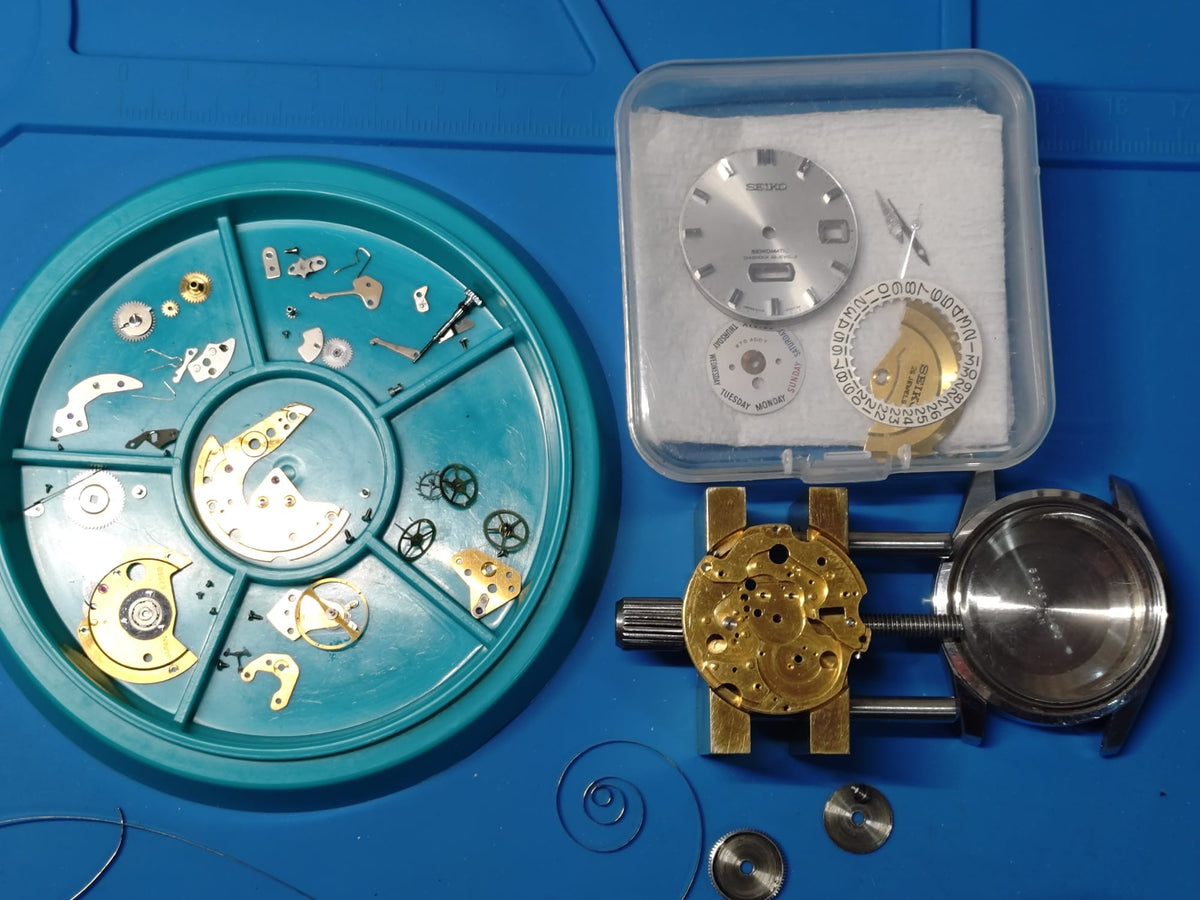


Seiko Seikomatic Weekdater – Ref. 6206-8130 – Caliber 6206B, Automatic, Suwa Seikosha – June 1966 – freshly serviced
Seiko Seikomatic Weekdater – Ref. 6206-8130 – Caliber 6206B, Automatic, Suwa Seikosha – June 1966 – freshly serviced
The crown is positioned at four o'clock, recessed into the side of the case. On the wrist, you don't feel it at all. A detail that makes the Seikomatic range unmistakable – and one that only makes sense where there is nothing to wind.
For this watch has no manual winding. The caliber 6206 winds exclusively through the movement of the wearer. That was exactly the point in the mid-1960s: a watch you put on in the morning, which displays the day and date, and which you never have to touch again.
The Weekdater and the Japanese office life of the 1960s
"Weekdater" was the name Seiko gave to those Seikomatic models that featured the day of the week spelled out in addition to the date. What seems taken for granted today was a status symbol back then: anyone in the Japanese business world of the mid-1960s wearing a watch that displayed the day and date and wound itself had clearly spent some money.
The Seikomatic line was Seiko’s automatic flagship of those years and was expressly aimed at the "modern businessman." It stood above the Sportsmatic and Seiko 5 series and below the King Seiko and Grand Seiko lines—with the difference that Grand Seiko did not yet have any automatics in its range at that time.
The Caliber 6206B – and what became of it
The caliber 6206 appeared in May 1964 as the successor to the caliber 400, an automatic movement with 33 jewels. Seiko consciously simplified the design to 26 jewels to be able to manufacture it in larger quantities at reasonable costs. The result became one of the most widely produced Seiko movements of the decade.
Technically, it offers:
- Automatic winding with no manual winding capability
- 26 jewels, gold-plated movement
- 18,000 vibrations per hour
- Diashock shock protection – Seiko’s own balance bearing system introduced in 1956
- Day and date, both with applied, polished window frames
But the real point is elsewhere: it was from this 62-series movement family that the first automatic Grand Seiko emerged, the 62GS of 1967. The Seikomatic is therefore not a secondary line, but the series platform on which Seiko developed the automatic technology that subsequently moved into the top-tier line. Anyone holding a 6206 holds the immediate forerunner of the first automatic Grand Seiko.
Dial and Case
The silver dial features a fine sunburst finish that radiates from the center outwards. The hour markers are applied, multi-faceted batons with polished flanks and a satin-finished top—executed as a double index at 12 o'clock. Complementing these are broad, blued-effect dauphine hands and a slender central second hand.
Both calendar windows are framed with applied, polished metal borders: the date at three o'clock, the day of the week written out above the six. This arrangement—day at the bottom center instead of next to the date—is the visual hallmark of the Weekdater and gives the dial a symmetry that the standard 3 o'clock dual display lacks.
Running around the edge is a slightly raised, satin-finished ring with a fine minute track. Because the bezel is very narrow, the watch appears to consist almost entirely of the dial.
The stainless steel case has angular, downward-sloping lugs and a polished, slightly domed bezel. With a diameter of 36.7 mm and a lug-to-lug distance of 43.9 mm, it wears with restraint but does not feel small.
The dolphin on the caseback
The caseback bears the embossed inscription "SEIKO WATER PROOF" around a leaping dolphin. Seiko used this mark in the 1960s to identify watches with waterproof construction—it is a sought-after detail today because the caseback on many specimens has been replaced or polished smooth over the decades. Here, the embossing is completely and sharply preserved, as are the reference 6206-8130 and the serial number 6615004.
Notwithstanding this historical designation, the note at the end of this description applies: with a sixty-year-old watch, water resistance cannot be guaranteed.
Condition
Technically flawless. The watch was professionally serviced in Japan in the spring/summer of 2026—fully disassembled, cleaned, oiled, and regulated. The automatic winding, date, and day-of-the-week switching function perfectly.
The dial is exceptionally well preserved: uniform sunburst finish without spots or discoloration, markings complete, applied indices and window frames free of corrosion. After more than sixty years and a case that is likely to have been opened multiple times during that period, this is by no means a given.
The case shows light, age-appropriate signs of wear; the edges are preserved, and the watch does not look over-polished. The caseback has fine scratches from opening it, but the dolphin embossing is not affected by this. The crystal is clear.
Fitted is a new black leather strap with a grained surface.
Operation
The caliber 6206 cannot be wound by hand. If the watch has been lying idle for a while, you start it by gently swaying it; it will start running after about thirty seconds. The day of the week does not have a quick-set feature—to set it, you turn the hands past midnight. As with all Seiko movements of this type, calendar switching should not be performed between approximately 9 p.m. and 3 a.m., as the switching mechanism is already engaged during this time.
Technical Specifications
- Brand / Line: Seiko, Seikomatic (Weekdater)
- Reference: 6206-8130
- Serial number: 6615004
- Production date: June 1966
- Movement: Seiko caliber 6206B, automatic without manual wind, 26 jewels, 18,000 vph, Diashock
- Manufacturer: Suwa Seikosha, Japan
- Functions: Hours, minutes, central seconds, date, day of the week
- Case: Stainless steel, caseback with dolphin embossing, recessed crown at four o'clock
- Diameter (excluding crown): 36.7 mm
- Height: 11.9 mm
- Lug-to-Lug: 43.9 mm
- Lug width: 19 mm
- Weight (incl. strap): 55 g
- Strap: New black leather strap
- Crystal: Acrylic glass
- Service: Spring/summer 2026, Japan – full disassembly, cleaning, oiling, regulation
For whom
For collectors who want to fully understand the Grand Seiko line—the 6206 is the movement family from which the first automatic Grand Seiko emerged, and it costs a fraction of the price. For anyone looking for an everyday watch with day and date that requires no battery and no daily winding. And for fans of mid-1960s design: applied indices, narrow bezel, recessed crown, symmetrically placed calendar windows—a design language that simply isn't built this way anymore today.
Warranty (used)
This is a used item. The limitation period for claims for defects (statutory warranty) is 12 months from delivery.
Note
As this is a vintage watch, water resistance cannot be guaranteed. To protect the movement, the watch should not come into contact with water or moisture.
Legal guarantee:
Share